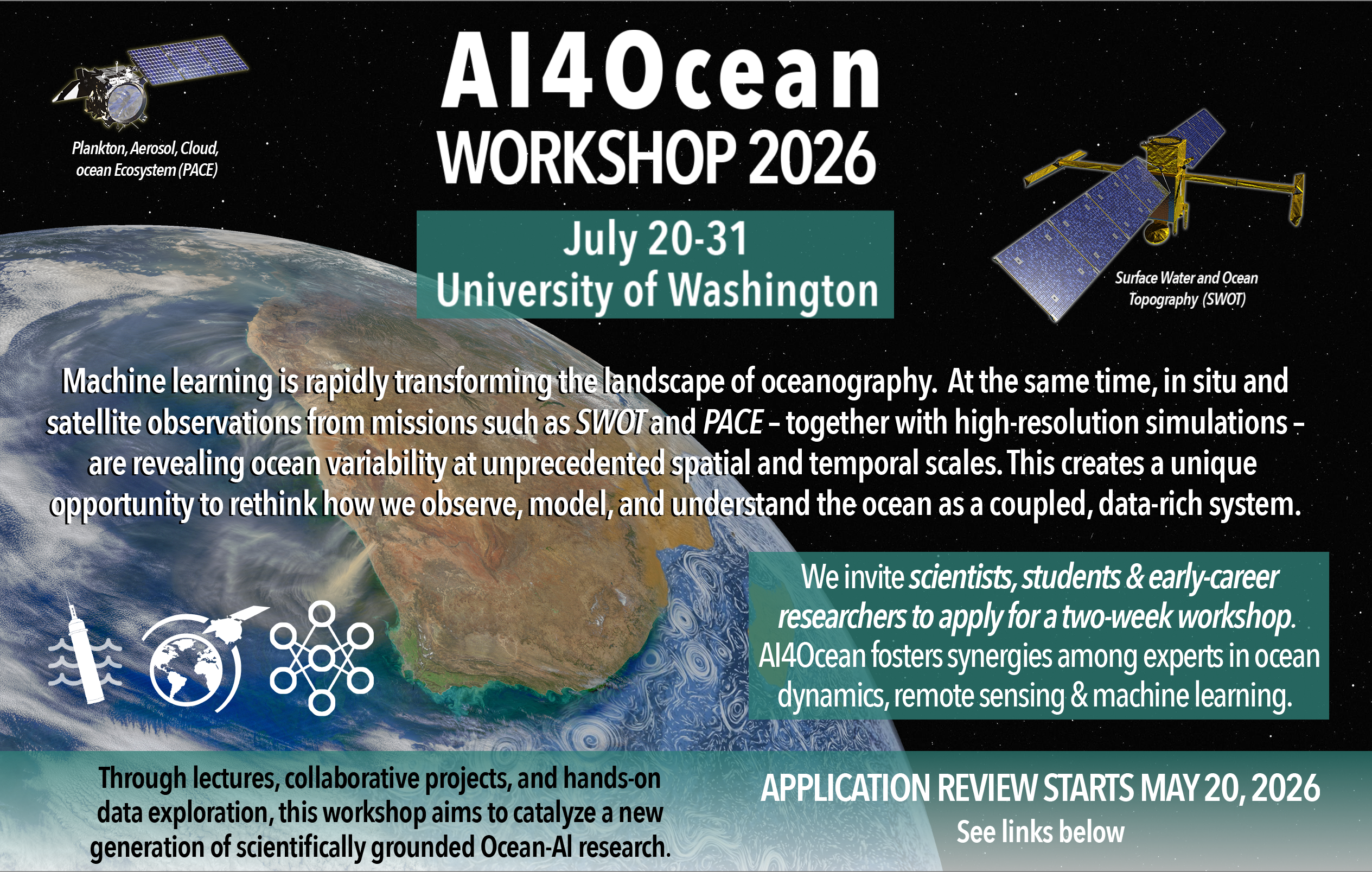

We will commence reviewing applications on May 20th and continue on a rolling basis until we reach our maximum capacity of 50 participants. Final decisions will be communicated no later than June 15, 2026.

Undergraduate applicants to the Data Science in Oceanography program should apply via the following link: Undergraduates apply here.

All other applicants should use the general application form.


checkmark Experts provide tutorials on observing systems, remote sensing and AI

checkmark Teams use machine learning-ready datasets in hackathons

checkmark Participants develop collaborative research projects guided by mentors

checkmark Final project presentations and potential collaborative proposals

checkmark Professional development opportunity discussions for students and early-career scientists

AI4Ocean Goals

collaboration by teammates
Build an Ocean-AI Community Foster a cross-disciplinary community with a shared vision of advancing ocean science through innovative data science and AI technologies. Promote collaboration across domains, institutions, and career stages.
network paths
Establish Scientifically Rigorous Pathways for AI in Oceanography Define clear machine learning practice to ensure research outcomes are consistent with known ocean dynamics. This ensures that AI methods contribute meaningfully to scientific understanding.
future data
Enable Future Ocean Observations Through AI Innovation Identify where AI can transform ocean observing systems, data assimilation, and predictive capabilities. This will lay the groundwork for future observing system concepts and strategic ocean-AI integration.
Organizers: Jinbo Wang (jinbo.wang@tamu.edu), Georgy Manucharyan (gmanuch@uw.edu), Nadya Vinogradova
Steering Committee: Andrew Thompson, Xavier Prochaska, Sarah Gille, Steve Nerem, Ian Fenty, Luke Van Roekel, Justin Stopa
NASA Logo National Science Foundation Logo

This AI4Ocean workshop is sponsored by NASA and the National Science Foundation
TAMU Logo Washington Logo AI4 Ocean Logo